

6–6.5 Mohs · Triclinic
Blue · Teal · Gold

The northern
lights beneath
the surface.
Some stories say the northern lights once lived within stone, held close in darkness until the earth itself was struck open.
Along the coast of Labrador, legend tells of a warrior raising his spear to the rock and releasing the aurora into the night sky. Veils of green and blue rose above the landscape while fragments of that light remained hidden beneath the surface.
Labradorite still carries something of that feeling. Its color does not rest plainly on the stone. It waits. It slips in and out of view, appearing only through movement, angle, and light.
This quiet reveal is part of its allure: a flash of blue, a pulse of teal, a hidden brightness that disappears as quickly as it arrives.
Color born
from structure.
Labradorite’s flash is not pigment resting plainly on the surface. Its color emerges through hidden internal layers formed slowly over geological time, revealing itself only through movement, angle, and light. What appears one moment in electric blue or spectral gold may disappear the next, giving the stone its shifting, almost atmospheric quality.

Light enters the surface of the stone rather than simply reflecting from the outside.

Thin internal layers scatter and bend the light, separating certain wavelengths within the stone.

At the right angle, blue, teal, gold, or spectral color appears, then vanishes as the stone moves.
the optical phenomenon in which hidden color appears from within labradorite as light moves through its internal structure.
A color that
never stays still.
Labradorite is most alive when it moves. A stone may appear quiet from one angle, then flare suddenly with blue, green, or gold as it turns toward the light.
This is part of its allure. It does not offer itself all at once. It reveals, conceals, and reveals again, shifting with the body, the hand, the room, the hour.
In jewelry, that movement becomes intimate. The stone changes with the wearer, catching light in passing moments rather than holding one fixed expression.
No two stones
reveal the same light.
Labradorite’s colors depend on the thickness and orientation of its internal layers. This structure filters light differently, creating blues, teals, golds, and full-spectrum flashes.

Strong blue flash is usually produced when light reflects through thinner internal layers within the feldspar.

Teal and green tones form when light travels through slightly thicker or differently oriented layers.

Gold and copper flashes appear when longer wavelengths are reflected through the stone’s internal structure.

Multicolor flash comes from varying layer thicknesses reflecting several wavelengths at once.
Why shifting light
feels alive.
The human eye is naturally drawn to movement, contrast, and change. Labradorite holds attention because its light behaves unpredictably, appearing suddenly before slipping away again across the surface of the stone.
Unlike gems that remain visually constant, labradorite shifts with every movement in angle and illumination. This instability creates depth and presence, as though something luminous exists beneath the mineral itself.
Its beauty depends on interaction: light meeting movement, movement meeting the eye, and the stone revealing itself differently each time it is seen.
Named for the land
where it was found.
Labradorite was first identified near the coast of Labrador, Canada in the late eighteenth century, where its shifting blue flash was unlike any stone previously recorded.
Early reports described flashes of blue and green appearing beneath dark coastal stones, giving rise to legends that the northern lights had become trapped within the earth itself.
Spectrolite, a vivid Finnish variety discovered during the twentieth century, is known for unusually strong multicolored flashes that span nearly the full visible spectrum.
Today, Madagascar produces many of the highly luminous stones used in contemporary jewelry, prized for their intense electric blue and teal flashes.

Though now found across several regions of the world, the stone still carries the name of the northern coastline where its hidden light was first recognized.
Light, held
against gold.
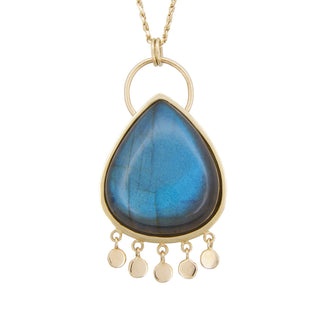
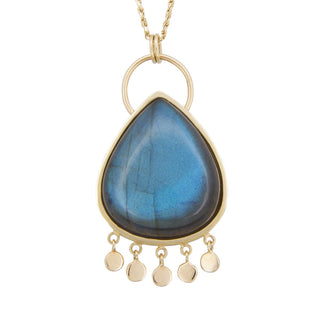
Labradorite carries an unusual balance of darkness and illumination. Its body tone is often smoke-gray or deep charcoal, yet flashes of blue, teal, and gold appear suddenly across the surface with striking intensity.
In jewelry, this contrast becomes especially compelling beside gold. Warm metal amplifies the cooler light within the stone, while satin surfaces soften reflections and allow the flash itself to remain the focal point.
Worn against the skin, labradorite feels intimate and atmospheric. Its shifting color gives even minimal forms a sense of depth, presence, and quiet tension between shadow and light.


A stone that never
fully reveals itself.
Long before it became a gemstone, labradorite existed as a quiet mineral hidden within ancient rock. Its brilliance is not immediately apparent. It waits beneath the surface, revealed only when the stone is cut and turned toward the light.
That transformation has captivated people for generations. From carved objects and collector specimens to contemporary jewelry, labradorite continues to be valued not only for its color, but for the sense of discovery it inspires.
In every flash of blue, teal, or gold, there remains a reminder of the remarkable journey from stone to adornment.